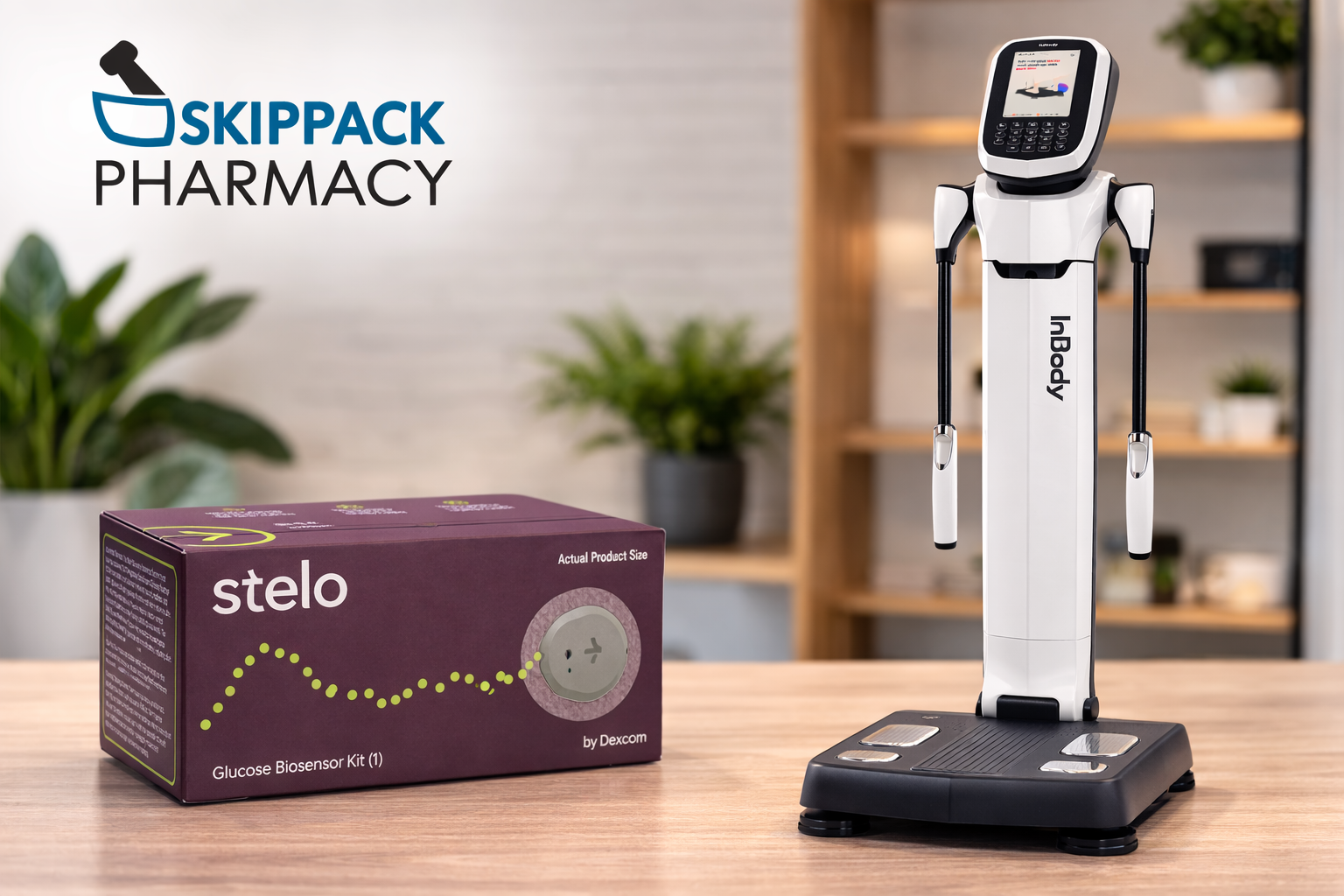
- Skippack Metabolic Health
-
by Skippack Pharmacy
A moment when “health” turns into an urgent question
Imagine the scene. You’re a working single parent, exhausted after a long shift and ready to head home. You’re mentally planning dinner, thinking you’ll “try to be healthier,” when you realize you don’t actually know what foods make you feel energized… and which ones leave you foggy and hungry an hour later.
As you’re pulling up your notes app to plan “better meals,” your phone lights up with a headline: the U.S. The Food and Drug Administration has cleared the first over-the-counter continuous glucose monitor; meaning some people can now purchase glucose-tracking technology without a prescription.
If you’ve ever been told to “watch your sugar,” “cut carbs,” or “focus on metabolic health,” you already know the frustrating part: advice is easy to hear, but hard to personalize. A single lab value can feel abstract. And a bathroom scale can’t tell you what your weight is made of (muscle, fat, water).
That’s the gap the Skippack Total Health Program is meant to address by pairing two modern tools that can make health trends easier to see, understand, and act on over time.
What the Skippack Metabolic Health Program is designed to do:
The Skippack Metabolic Health Program is built around one simple idea: better decisions happen when you can actually see patterns.
Two of the tools highlighted in this program are:
- Stelo, an over-the-counter continuous glucose monitoring system cleared for adults who are not using insulin
- InBody scans, which use bioelectrical impedance analysis (BIA) to estimate body composition (how much of your body is muscle, fat, and water), rather than showing only total weight
These tools do different jobs, so they’re covered separately below.
Stelo OTC continuous glucose monitoring
What Stelo is and how it works:
Stelo is an over-the-counter continuous glucose monitor cleared for people age 18 and older who are not on insulin, designed to continuously measure and display glucose values using a wearable sensor plus a smartphone app.
Stelo uses a small sensor (a thin wire inserted just under the skin) that detects glucose in interstitial fluid, the fluid just beneath your skin. The sensor’s readings are processed into estimated glucose values and shared to the app.
A few practical details matter for “real life” use:
- The Stelo system can be worn for up to 15 days per sensor
- The app presents readings every few minutes
- Stelo does not provide glucose alerts or alarms
- The display range is 70–250 mg/dL
What problems Stelo solves for many people:
For many patients, the hard part of metabolic health isn’t motivation, it’s uncertainty. Fingerstick testing (if done at all) is often spot-checking, and it can miss how meals, sleep, stress, and movement interact. Stelo is intended to help people better understand how diet and exercise can impact glucose levels and trends. This kind of trend visibility can help you notice what tends to push glucose higher or lower over a day or week. There is clinical evidence that continuous glucose monitoring can improve glucose outcomes in type 2 diabetes not treated with insulin, compared with standard blood glucose monitoring approaches. Studies report improvements including better glycemic control and higher time in range.
What Stelo does not do and why that matters:
A continuous glucose monitor is powerful, but it is not magic, and it should be used safely and appropriately. Stelo is not for everyone. The FDA specifically highlights that this over-the-counter system is not for individuals with problematic hypoglycemia, because it is not designed to alert the user to dangerous lows. Stelo’s safety information also warns not to use it if you have problematic hypoglycemia, and not to use it if you are on dialysis (performance hasn’t been evaluated for that population).
Continuous glucose monitor readings can lag behind blood glucose. Because continuous glucose monitors measure glucose in interstitial fluid, there can be a delay of approximately 5-15 minutes compared with fingerstick blood glucose, especially when glucose is changing quickly (for example, after meals or during/after exercise). During rapid glucose changes or exercise, this lag time can increase to 12-24 minutes or longer. You shouldn’t make medication changes based on the number alone. Stelo labeling materials emphasize that users should consult a qualified health professional rather than taking medical action based solely on device output.
Finally, a note that protects patients from misinformation: the FDA has warned consumers not to rely on smartwatches or smart rings that claim to measure blood glucose without piercing the skin, stating it has not authorized, cleared, or approved such devices for that purpose. Continuous glucose monitors like Stelo are different, they use a sensor under the skin.
InBody body composition scans:
If you’ve ever stepped on a scale and thought, “I’m doing everything right, why isn’t the number changing?”, you’re not alone.
A key limitation of scale weight is that it does not tell you what changed:
- Did you lose fat, lose muscle, or lose water?
- Did your “weight” stay the same while your body composition improved?
This is exactly the kind of question InBody scans are designed to help with.
What an InBody scan is:
The InBody Test is a non-invasive body composition analysis intended to provide a breakdown of weight in terms of muscle, fat, and water, helping put real context around the number on the scale. The InBody result sheet is designed to display body composition measurements in a clear, easy-to-read format. Result-sheet information is educational and not medical advice.
How InBody scans work:
InBody devices use a method called bioelectrical impedance analysis (BIA). BIA sends low-level electrical currents through the body via electrodes to measure impedance (resistance), and then uses those impedance values to estimate total body water, fat-free mass, and body fat.
Because BIA relies heavily on body water distribution, hydration, food intake, and recent exercise can influence results. InBody’s preparation guidance explicitly emphasizes that “small changes in your daily routine can influence the data,” and provides steps for more consistent measurements. Research supports this general limitation of BIA methods: acute fluid intake can measurably impact body composition assessment via BIA, reinforcing why standardized pre-test conditions matter.
Patient Health Begins with Body Composition Analysis :
How are you tracking your fitness progress?
If you’re like most people, you step on your bathroom scale when you want to assess your health. But doesn’t it feel like none of your plans to get healthier work out the way you expected them to?Doesn’t it seem like that new diet or exercise you’ve been trying only helps you lose weight temporarily, and sometimes, you end up gaining even more weight? That’s because your bathroom scale is misleading.
Ditch the scale
Weight loss is not the same as fat loss. As we age, we naturally lose some of our heavy, dense muscle mass, and a lower number on the scale doesn’t always mean we’re in peak condition. The key to physical fitness is losing excess body fat, not overall body weight. Instead of tracking how heavy you are, use body composition analysis to track how healthy you are.
See what you’re made of
You are much more than one standardized number. Your weight is made up of muscle, fat, bone, and water, and the proportions of these different elements are known as your body composition. When you take a body composition test on the InBody 380, it shows you how many pounds of muscle, fat, bone, and water you actually have. Armed with this data, you can make little adjustments that lead to major long-term improvements.
By learning about the balance of muscle mass, body fat, and body water in each of your limbs and your trunk, you get insight into:
- Your current health status
- Risk of Chronic Disease
- Which exercise and nutrition plans are most effective for you
Take control of your health.
The InBody 380 analyses your body composition in just 30 seconds and provides you with a comprehensive set of results that you can use to optimize your lifestyle. By checking your Result Sheet printout or your InBody App data, you’ll be able to notice any changes in:
- Skeletal Muscle Mass
- Percent Body Fat
- Body Fat Mass
- Basal Metabolic Rate
- Abdominal Fat Analysis
- And more!
Use the customizable Body Composition History to personalize which outputs are displayed and see how specific outputs, such as Percent Body Fat, change over time. Take an InBody Test every two to four weeks to continuously monitor your progress towards your fitness goals.
They can help:
- Establish a baseline of fat mass, fat-free mass, and body water related measures, then track how those shift as habits change
- Create more consistent progress check-ins: InBody itself recommends repeat testing under the same conditions
- Bring structure to weight-focused goals, where maintaining or improving muscle mass is often as important as reducing fat mass for long-term health and function (especially for adults trying to lose weight without losing strength).
Research shows that certain InBody analyzers can demonstrate good test-retest reliability and may be used when more advanced methods are not available, while still having important limitations related to accuracy compared to reference methods.
What to expect when you use these tools through the program
Whether you’re looking for a clearer picture of glucose patterns (Stelo) or a clearer picture of what the scale number represents (InBody), the safest and most valuable approach is to focus on patterns over time.
A practical, patient-friendly mindset backed by how these tools are designed:
- For glucose tracking, look for repeated patterns (meal timing, activity timing, sleep) rather than reacting to a single number, especially since continuous glucose monitor values can lag behind blood glucose
- For body composition, aim for repeat scans under similar conditions (time of day, hydration, time since last meal, no recent intense exercise) so your “trend line” is more meaningful
- For both tools, use the information to guide conversations with a pharmacist and your healthcare team, not as a substitute for diagnosis or treatment decision
Ready to see your own health patterns more clearly?
Explore the Skippack Metabolic Health Program and learn how Stelo glucose tracking and InBody body composition scans can help you better understand your metabolic health over time.
👉 Get started or order your device here:
https://www.skippackpharmacy.com/bodyiq/
Email clinic@skippackpharmacy.com if there are any specific requests or things our team should be aware of prior to your visit.
By Dr. Efrain Santiago PharmD, MBA
References:
- Improving the Clinical Value of CGM Systems: Joint EASD & ADA Statement
- Exercise Glucose Management in Type 1 Diabetes: EASD/ISPAD Position Statement
- CGM Sensor Time Delay: Causes and Solutions
- Timing Differences Between Interstitial and Blood Glucose
- Reliability and Validity of Bioelectrical Impedance Devices
- Real-World Evaluation of Multi-Frequency BIA for Body Composition
- ASPEN Guidelines on Body Composition Assessment in Clinical Populations
- BIA vs DXA for Body Composition in Children
- Diabetes Technology Standards of Care (ADA 2026)
- Laboratory Guidelines for Diabetes Diagnosis and Management
- CGM in Non-Insulin Type 2 Diabetes: Systematic Review and Meta-Analysis
- Effectiveness of CGM in Type 2 Diabetes: Systematic Review and Meta-Analysis
The information contained in this article is intended for educational and promotional purposes only. It is not intended as specific medical advice. Call us or visit us in person and speak with a pharmacist for specific medication queries and consult with your physician or provider for your specific medical condition or health goals.